
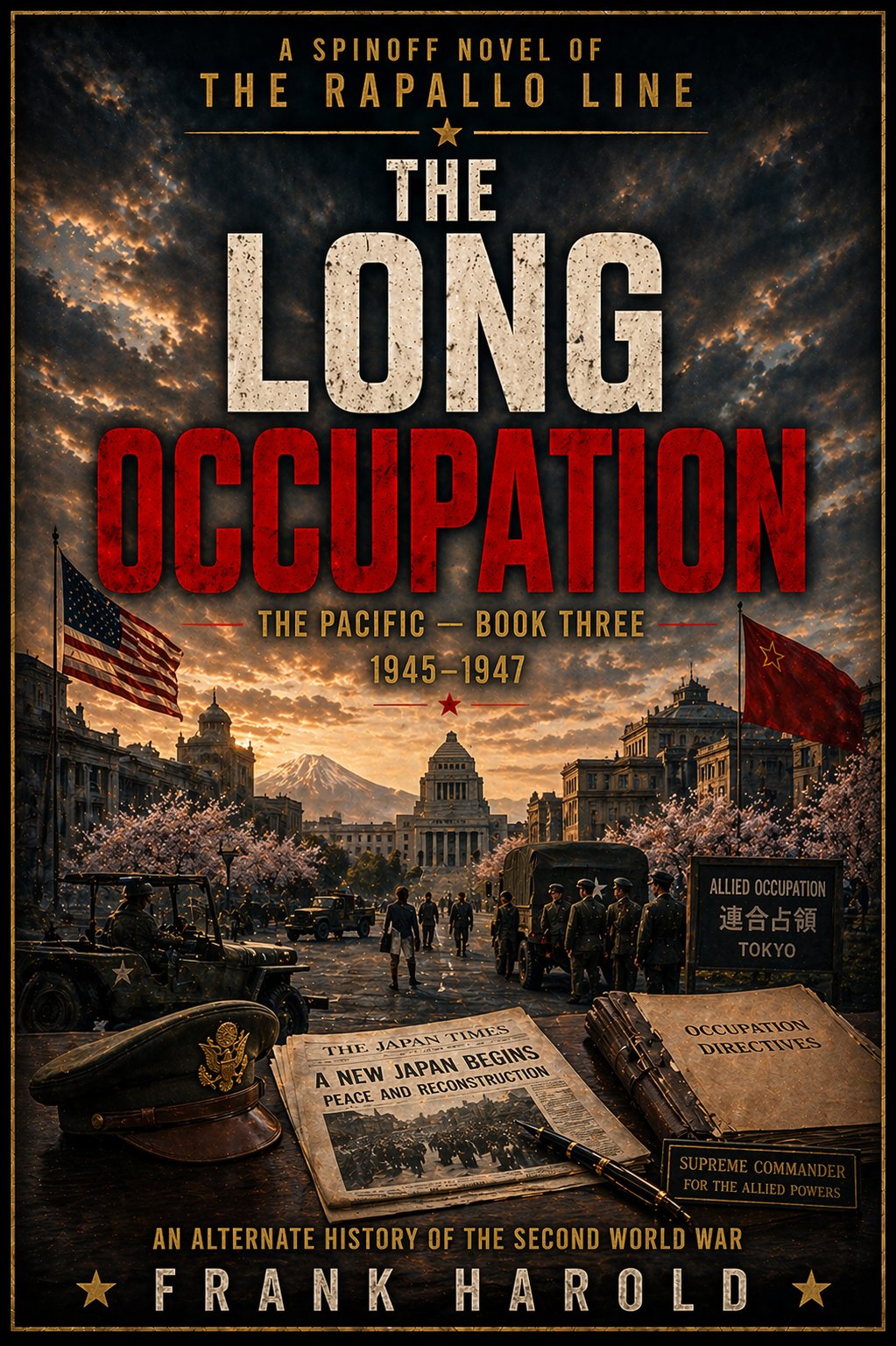
The Rapallo Line · Pacific Trilogy · Book Three
The Long Occupation
by Frank Harold
USS Missouri, Tokyo Bay, 2 September 1945. The Japanese delegation comes aboard at eight-forty in the morning. A Foreign Minister with a cane signs the instrument of surrender first; a General of the Army signs second. At the Soviet signature, a Japanese Army colonel looks up, for the first and only time, at the Soviet representative crossing to the desk — and in that small gesture, the shape of the next decade of the Pacific is, privately, established.
The Long Occupation covers the postwar period from the signing through the winter of 1946-47 — an American-led occupation conducted under Soviet observation, a multi-power arrangement for which there was no precedent in the reader's world. An American captain who was, a year earlier, a carrier lieutenant commander at the Luzon action becomes a liaison officer between CINCPAC and Soviet military headquarters. A Japanese Foreign Minister begins the slow work of a constitutional reconstitution his country has not, in its institutional memory, ever previously undertaken. And the Tokyo Tribunal of 1946 opens on terms that neither the prosecution nor the defence will afterwards recognise as the ones they expected.
The Long Occupation is the closing volume of the Pacific Trilogy and the final volume of the Rapallo Line sequence as a whole. It is the book about the peace after the war that did not end cleanly, and about the men and women who understood — in Washington, in Moscow, and in Tokyo, by the late winter of 1947 — that the war whose shooting had stopped in August 1945 had not, in the deeper sense, actually finished.
Coming Soon
Coming to Amazon · Summer 2026
Frank Harold
The Rapallo Line
Pacific Trilogy · Book Three
47,366 words
Kindle ebook