
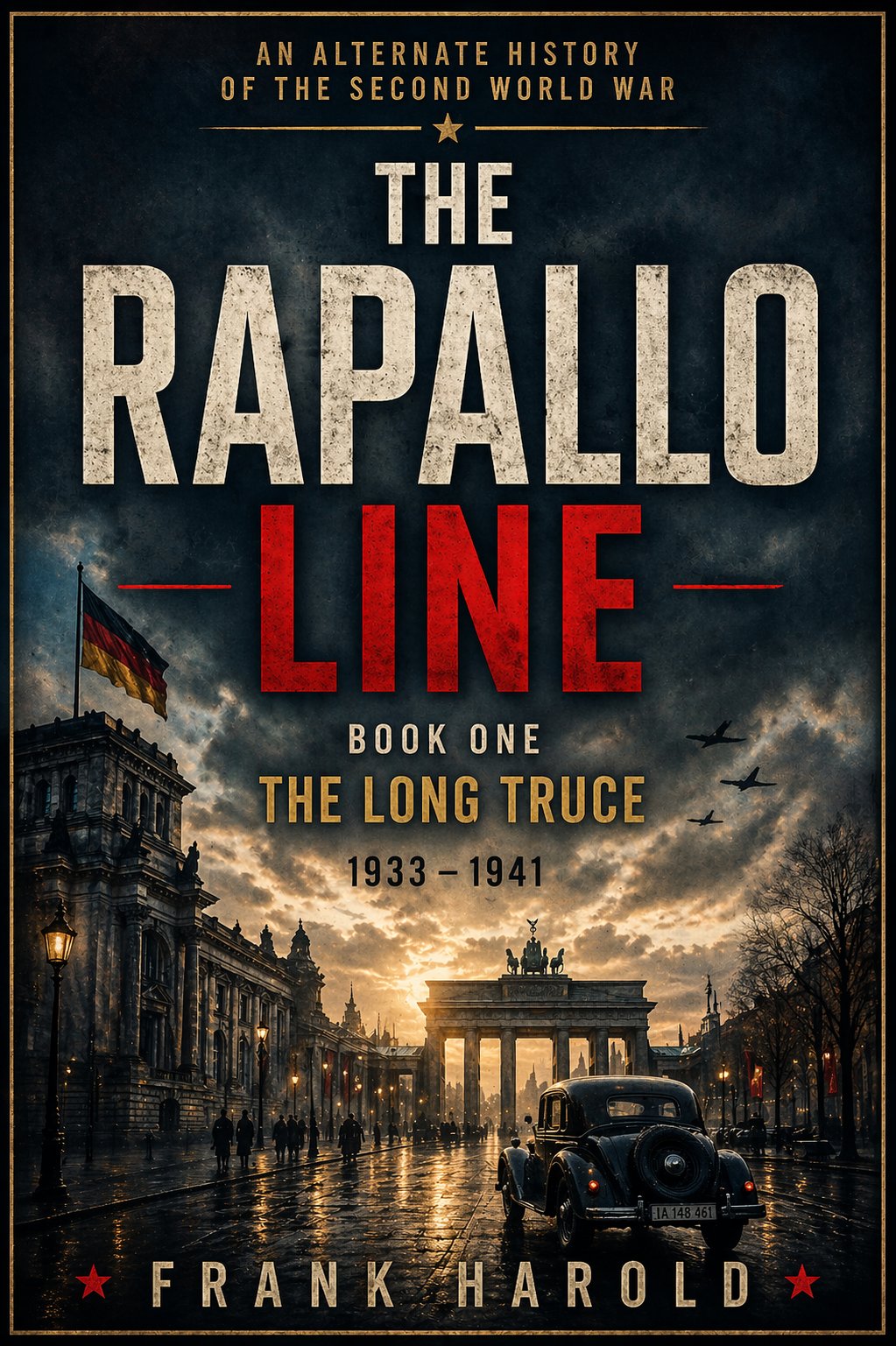
A taste of the opening
Read the first pages
The opening of the book — roughly 3,234 words — to let the voice do its own argument.
Author’s Note
The Rapallo Line is a work of alternate-historical fiction. Its premise — that the Rapallo Pact between the German Reich and the Soviet Union, signed in 1922 and renewed in 1939, held through the Second World War and reshaped the alliances of the decade that followed — diverges deliberately from the historical record. Named figures, including Adolf Hitler, Joseph Stalin, Winston Churchill, Franklin D. Roosevelt, Reinhard Heydrich, and Heinrich Himmler, appear in invented situations; their dialogue and specific actions in these novels are fictional.
The Holocaust is referenced in this series because any honest counter-factual set in occupied Europe must reckon with it; I have tried to depict those references with the gravity the subject demands, and without invention of new atrocities beyond the historical record.
Readers interested in the real history against which the alternate is set will find a short discussion in the Historical Note that follows.
A Historical Note
This novel is an alternate history. The point of departure is a decision taken in Berlin on the morning of the sixth of March 1933, when the Minister of the Reichswehr, Werner von Blomberg, brought to the Reich Chancellery a recommendation on the future of the secret German–Soviet military cooperation arrangements known as the Rapallo facilities — Kama, Lipetsk, Tomka. In the history we inherited, his recommendation was accepted, and the facilities were closed within the calendar year. In this telling, the recommendation was not accepted, and the facilities continued. What follows in this book, and in the books that come after it, is what followed from that decision. A fuller account of the real history against which the novel is set will be found in the Historical Appendix at the end of this book.
CHAPTER ONE
The Kazan Letter
Berlin. 6 March 1933.
The rain that fell on Wilhelmstraße was the kind that did not clean anything. It carried the coal smoke down from the roofs and laid it along the gutters in a black paste mixed with the ash from the Reichstag, still blowing about the city a week after the fire. In the cabinet room of the Reich Chancellery the smell of it came in through the sash windows and sat in the throat of every man present.
Werner von Blomberg, Minister of the Reichswehr for five weeks and six days, stood at the long table with a blue folio flat in front of him. He had rehearsed what he meant to say. He had rehearsed it in the car from the Bendlerstraße and again walking across the courtyard and once more in the anteroom while Papen ignored him over a newspaper. He was not a man who rehearsed things, and that was why the thing mattered.
The Chancellor came in without ceremony, flanked by an adjutant and a secretary with a pad. He was, Blomberg noticed, very tired. The skin under his eyes had a color that Blomberg had last seen on the faces of officers returning from winter quarters on the Eastern front in the last war.
“Herr Reichskanzler,” Blomberg said.
Hitler gestured for him to sit. Hammerstein, the chief of the Army Command, was already in his chair, his long face empty of anything one could call deference. Neurath sat stiffly beside him. Papen lounged at the far end with his newspaper folded on his knee. Göring was not there, which was a mercy.
“You have five minutes,” Hitler said. “Speak.”
Blomberg did not sit. He put his hand flat on the folio and kept it there.
“Herr Reichskanzler. In the year 1922 at Rapallo, at a time when the Reich was forbidden an army, the Reich signed a treaty with the Soviet Union. Since that time there have existed in Russia three installations. At Lipetsk, an air school. At Tomka, a facility for the study of defensive measures against poison gas. At Kazan — we have called it Kama in our correspondence — a tank school. Nine hundred German officers have passed through Kama since 1929. Another four hundred through Lipetsk. The entire theoretical base of our Panzerwaffe rests, at this moment, in foreign territory.”
Hitler’s face had not changed. Blomberg went on.
“Last December the Reichswehrministerium concluded that the installations should be closed. The reasons were political. It was believed that the new government would wish to be seen to be anti-Bolshevik. I signed the order myself. I signed it six days before the Herr Reichskanzler took office.”
A small nod from Hammerstein. He had opposed the order. It was the one thing he and Blomberg had agreed on in January.
“The order has not yet been transmitted to Moscow,” Blomberg said. “The courier left Berlin on the fourteenth of February and was delayed in Warsaw by a matter of his passport. He is at this moment in the consulate at Riga. He has been instructed to await further word.”
Hitler was looking at him now. Very directly.
“You held the courier.”
“I held the courier.”
There was a silence that Blomberg had expected and did not fill. Papen rustled his newspaper. Neurath examined the ceiling.
“Why?” Hitler said.
“Because,” Blomberg said, “the Panzer arm of the German Reich cannot be constructed in German territory. Not in the next three years. Not in the next five. The Versailles inspectors still have a legal right to enter our country at forty-eight hours’ notice until 1935. Any tank we build here will be known in Paris and London the week it leaves the forge. A tank built at Kama will not. A pilot trained at Lipetsk cannot be counted in the columns of the Reichswehr. For the money the Reich will spend in the next three years on rearmament, Herr Reichskanzler, three-quarters of the return is in Russia or it is nowhere.”
He paused. Rain tapped on the window.
“And the political reasons?” Hitler said.
“The political reasons have not changed. You will say in your speeches what you must say. Marshal Voroshilov says what he must say. Neither of us believes the other. This has been the nature of the arrangement since 1922 and neither the Comintern nor the Party has suffered from it.”
Hammerstein lifted his eyes. “Herr Reichskanzler. I joined the Minister of Defense in opposing the December order. I have not changed my view. The Reich cannot rearm in isolation. We are surrounded by France, by Poland, by Czechoslovakia. We have no access to Rumanian oil except through Hungary, who will sell us nothing we cannot pay for in gold. The Soviets have oil. They have wheat. They have manganese and they have chromium and they have the whole of the Kuznetsk basin. If we close Kama we tell Stalin we are his enemy before we are ready to be his enemy.”
Hitler’s hand moved on the table. A small flat movement, thumb against the varnish.
“And if Stalin is our enemy in three years?”
“Then,” said Hammerstein, “in three years, he is our enemy. Today we need him.”
Papen coughed behind his newspaper. “The French will hear of this.”
“The French will hear what they have heard for eleven years,” Blomberg said. “They have known about Lipetsk since 1926. They have known about Kazan since 1930. They complain to Geneva, Geneva does nothing. There is nothing new to hear.”
Hitler was silent for a long time. Blomberg understood, then, why the man looked so tired. He had been in office thirty-five days and he had not yet slept a full night. Blomberg had heard it from the adjutant: the Chancellor paced, he read, he worked through the small hours. He was a man trying to reconcile a dozen futures at once and none of them quite fit.
“Bolshevism,” Hitler said at last, “is the enemy of the German people. I have said so. I will say so.”
“Yes, Herr Reichskanzler.”
“And yet.”
“And yet,” Blomberg agreed.
The Chancellor’s hand moved again on the table, the thumb against the grain.
“Do not close Kama,” he said. “Do not close Lipetsk. Do not close Tomka. Find the courier in Riga and send him home. Send him quietly. I want no word of this in any newspaper in the world. Not one.”
“Jawohl, Herr Reichskanzler.”
“General von Blomberg.”
“Herr Reichskanzler.”
“How many tanks are at Kama?”
“Six, Herr Reichskanzler. Two of them are new.”
“Ask the Russians for twenty more.”
Blomberg did not let his face move. Hammerstein, on his left, drew a slow breath.
“I will ask, Herr Reichskanzler.”
Hitler stood. The meeting was over. At the door he turned once.
“The General Staff will prepare a memorandum. I want a realistic proposal for cooperation with the Reds. Military. Economic. Secret. We will be their friends for as long as it serves the German people. Not one day longer. Is this understood?”
“It is understood, Herr Reichskanzler.”
He went out. The door closed. Papen folded his newspaper at last.
“Well,” said Papen, “that is a different man from the one who wrote Mein Kampf.”
Hammerstein turned his empty face. “No,” he said. “That is the same man. He has simply met the map.”
❖
Prenzlauer Berg, Berlin. Two nights later.
The Kneipe in Prenzlauer Berg had no sign. You went in through the tobacconist’s, past the counter, through a door that looked like a cupboard, and down four steps. Hauptmann Erich Brandt had been going there since 1929, when it had been a place where one drank badly and argued about Clausewitz. Now it was a place where one drank badly and said as little as possible.
He took his beer to a corner table. He was out of uniform. The rule was strict in his section: in civilian streets, in civilian clothes. His overcoat smelled of wet wool and the cheap soap the laundress used on Lützowstraße. He was twenty-eight years old and he had been in the Reichswehr since seventeen, and this was the first week in his life that he had wished he was not.
Two SA men came down the steps. Brown shirts under gray overcoats, the armbands folded under the lapels for modesty, and the faces of men who had been drinking since noon. They looked around the room with the particular kind of slow attention that was not looking for anyone in particular. Brandt did not lower his eyes. He did not raise them. He drank his beer.
A man sat down across from him. Civilian suit, brown, rumpled at the collar. Mid-forties. Tired. He put a small leather case on the table between them and did not open it.
“Hauptmann Brandt.”
“I do not know you.”
“You do not need to.” The man’s accent was Westphalian, or pretending to be. “I am to tell you that your orders for Special Training Command Kama are confirmed. You will report to the Anhalter station on the twenty-first at twenty-three hundred. Second-class compartment. You will be met in Warsaw. From Warsaw you will travel under a Lithuanian passport which will be given to you there. The cover is commercial. Agricultural machinery.”
Brandt set down his beer.
“Special Training Command Kama was suspended in January.”
“It was unsuspended on the seventh.”
“By whom?”
The man from the ministry looked at him without expression.
“By the Reich Chancellor. Personally. Do not mention his name in connection with this. Do not mention it to your wife. Do not mention it to your father, who is, I am informed, a Reichstag deputy for the Center Party. You will not see your father between now and the twenty-first. You will not see your wife between now and the twenty-first except under the cover story, which is that you have been posted to garrison duty in Allenstein. Your wife may write to you at an address in Königsberg. The letters will be forwarded. Is this understood?”
Brandt held the beer in his hand. The foam had gone.
“My father voted against the Enabling Law.”
“Your father’s vote is not relevant to this conversation.”
“It will be relevant to someone.”
“It will not be relevant to us, Hauptmann. You have been chosen for Kama because your examinations were the highest in your class and because your Russian, though bad, is not so bad that it cannot be improved. You are going to Russia to learn how to fight the Russians. This is a joke, if you find it one. I have found it one for three years.”
The man stood up. He had not opened the leather case. He slid it across to Brandt.
“Your ticket. Your advance pay. A letter from the ministry confirming your sick leave for the fortnight, in the event that anyone asks. Burn it after reading. Good evening, Hauptmann.”
He went up the steps. The SA men watched him go with the same slow attention that was not attention. Brandt put his hand on the leather case and did not open it.
Across the room a woman was singing, badly, something that had been popular before the war.
❖
Moscow. 20 March 1933.
Kliment Voroshilov was not a clever man. He knew this about himself and it did not trouble him. Clever men had a way of being shot in the corridors of the Lubyanka, and stupid men had a way of being sent to command cavalry divisions in the Urals, and he was neither, which was why at fifty-one he was the Commissar for Military Affairs and would remain so until the General Secretary decided otherwise.
The German note was on the desk in front of him. It was four pages long. It had arrived in the diplomatic bag from Berlin on the sixteenth and had been read first by Litvinov at Narkomindel, then by the Comintern, then by the NKVD, and finally by Stalin, who had written in the margin of the first page with a blue pencil in his round patient hand: Interesting. Show Voroshilov.
It was interesting. The Germans were asking for twenty more tanks at Kazan. They were asking for an extension of the lease on Lipetsk for a further five years. They were offering, in return, access to their new gas-engineering work at Tomka and — this was the part that had made Litvinov call in his deputy at midnight — a quiet understanding, in writing, that neither state would enter into any agreement with a third party directed against the other, for a period of ten years.
It was not a non-aggression pact. It was the shadow of one.
Voroshilov had not been in the room when Stalin had read the note. But Poskrebyshev had told him afterwards, in the corridor, that the General Secretary had laughed. Not loudly. A small, internal laugh, the sort he made when a thing had worked out exactly as he had predicted it would, three years earlier, to a man who was now dead.
The door opened without a knock. Stalin came in. He was in his plain gray tunic with no decorations, which meant he was in a mood to be practical. He took the chair across from Voroshilov and set his pipe on the desk without lighting it.
“The German has asked for twenty tanks,” he said.
“Yes, Koba.”
“Give him forty.”
Voroshilov blinked. Once.
“Forty?”
“Forty. And send Tukhachevsky to Berlin in the summer. Quietly. Not as a Marshal. As a technical adviser. Let him see their General Staff. Let them see him. I want them to know whom they are dealing with, in the event.”
“In the event of what, Koba?”
Stalin picked up the pipe. He turned it in his fingers.
“In the event,” he said, “that the German ever becomes clever enough to turn east. Which he will, eventually. But not in my lifetime, I think. And not in his, if we are careful.”
He stood up. At the door he turned.
“Kliment Efremovich. The German has a new Chancellor. He has written a book in which he said that the Russian is a subhuman. Do you know what I think about that book?”
“No, Koba.”
“I think,” said Stalin, “that it was written by a man who had not yet met a Russian with forty tanks.”
He went out. Voroshilov sat for a long time with the note in front of him. Then he reached for the telephone and asked for Kazan.
CHAPTER TWO
The Polish File
Kazan, Tatar ASSR. August 1933.
The steppe at noon was a single color from horizon to horizon and Major Dmitri Pavlovich Volkov disliked it for personal reasons that he did not propose to explain to anyone. He was thirty-four years old, second-in-command of the technical instruction at Kama, and the hood of the BT-2 he was sitting on was hot enough through his canvas trousers to have made a less disciplined man stand up.
In the dust two kilometers to the east a tank was running gun drill against four wooden targets in a triangle. The gunner was firing at speed across uneven ground. Three targets in two passes. The fourth would have been hit if the loader had not jammed the breech.
Volkov did not lower the binoculars. Beside him Lieutenant Sevastyanov, the political officer, was pretending to read a newspaper.
“Who is in the turret?” Sevastyanov asked.
“The German with the bad ear.”
“Brandt.”
“Brandt.”
Sevastyanov turned a page. “He is too good.”
“Yes.”
“I will have to write a report.”
“Write what you like. He is too good and I am also going to write a report. Mine will say give him a tank to take home.”
Sevastyanov set the newspaper down. “Dmitri Pavlovich, you understand that the German army is not our friend.”
“The German army is not our enemy either,” Volkov said. “It is what is in between, and what is in between is what they are paying us in tractors and machine tools and what we are paying them in steel. If we want to keep being paid we will let the German with the bad ear hit four targets and we will write him a certificate and we will send him home.”
He lowered the binoculars at last and looked across at the lieutenant. Sevastyanov was twenty-six. He had been a school teacher in Smolensk before the Komsomol picked him out. He believed in what he was doing in a way that Volkov had not believed in anything since 1921.
“Write the report,” Volkov said. “Send it to Voroshilov direct. Tell the Marshal that the German is an honest officer who shoots straight and does not drink to excess and learns Russian from a phrasebook in the latrine at four in the morning. Tell him the German has spoken twice in my presence about the necessity of cooperation between our two countries, and once about his wife, and never about politics. And tell him that I, Volkov, recommend that he be returned to Berlin in November with the highest grade we issue.”
“And privately?”
“Privately, Lieutenant, write down his name and remember it. In a war we will meet him on a field somewhere. I would like to know which field.”
Out on the steppe the BT-2 came round in a tight turn and the gunner put a fourth round into the fourth target before the dust from the turn had finished blowing east. Volkov nodded once. He did not smile. Smiling at a German was not a thing that happened twice in a career.
End of sample
Continue reading
The full 83,488-word book is available on Amazon as a Kindle ebook.
Available on Amazon →