
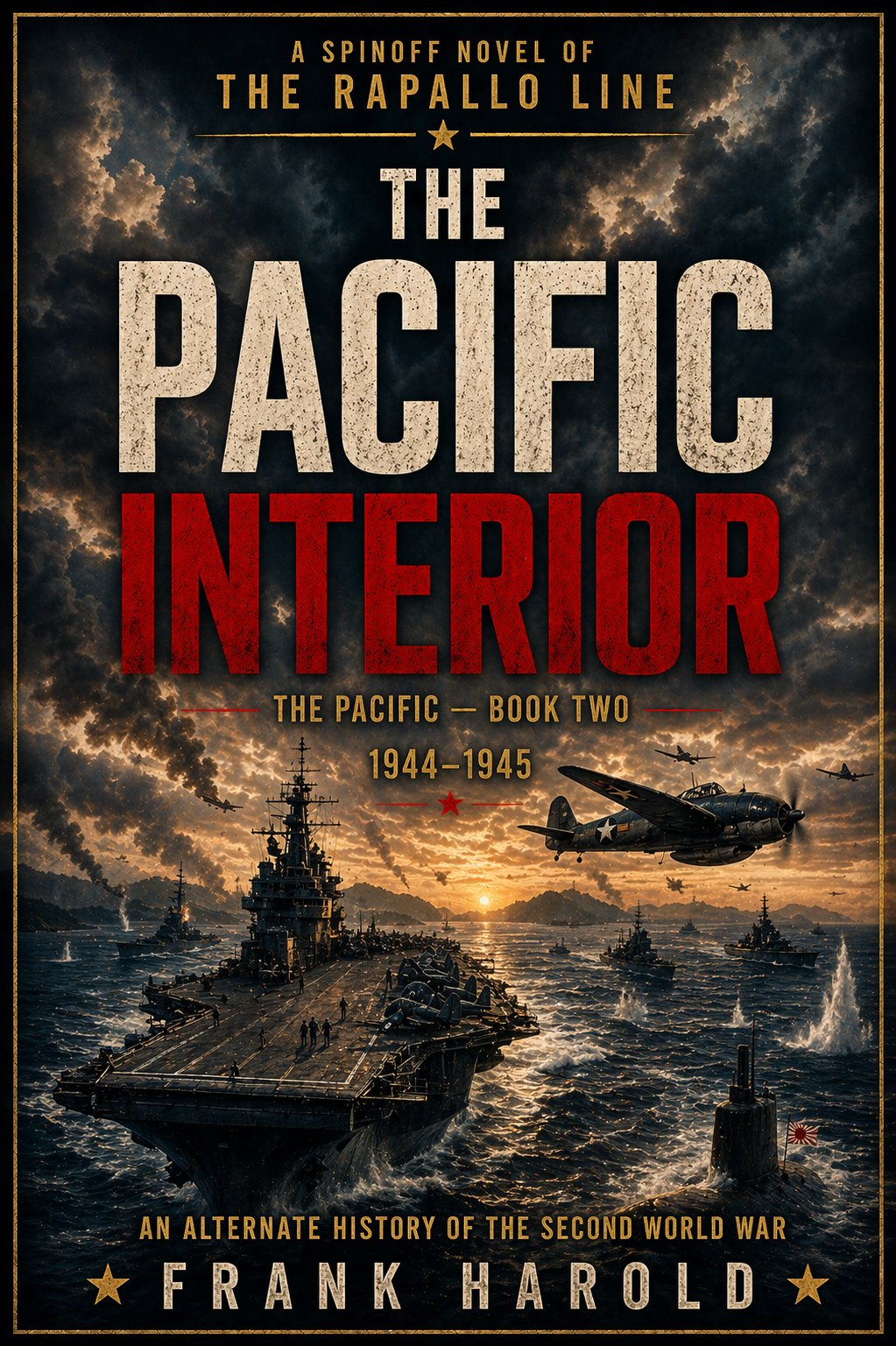
The Rapallo Line · Pacific Trilogy · Book Two
The Pacific Interior
by Frank Harold
December 1941. While Europe settles into the long arrangement between Berlin and Moscow, a second war opens on the far side of the world — a war the United States did not intend to fight alone, and cannot, by the arithmetic of 1942, hope to win on the timetable it has been given. From Pearl Harbor to the Coral Sea to the Aleutians, an American navy rebuilt on the fly, and an American army improvised from the militias of a continent, begin the longest and loneliest campaign of the twentieth century.
Across four years, a Japanese empire that has taken Singapore, Rangoon, Java, and Ceylon meets an American republic that has taken — slowly, at enormous cost — the habit of war. A naval officer aboard a carrier at Midway learns the meaning of a signal he should not have been able to read. A correspondent in Chungking sends dispatches no one in Washington will print. A diplomat in Lisbon, carrying instructions from a President who has not yet decided what he intends, meets a Japanese naval attaché across a café table and begins the conversation that will, in time, become the Manila Protocol.
The Pacific Interior is a companion volume to The Rapallo Line, standing a little apart from the main sequence. It is the story of the war the Europeans did not see — fought, in the phrase of one of its survivors, in the interior of an ocean, by a generation of Americans who came home afterward to a country that had already begun to forget them.
Coming Soon
Coming to Amazon · Summer 2026
Frank Harold
The Rapallo Line
Pacific Trilogy · Book Two
44,076 words
Kindle ebook