
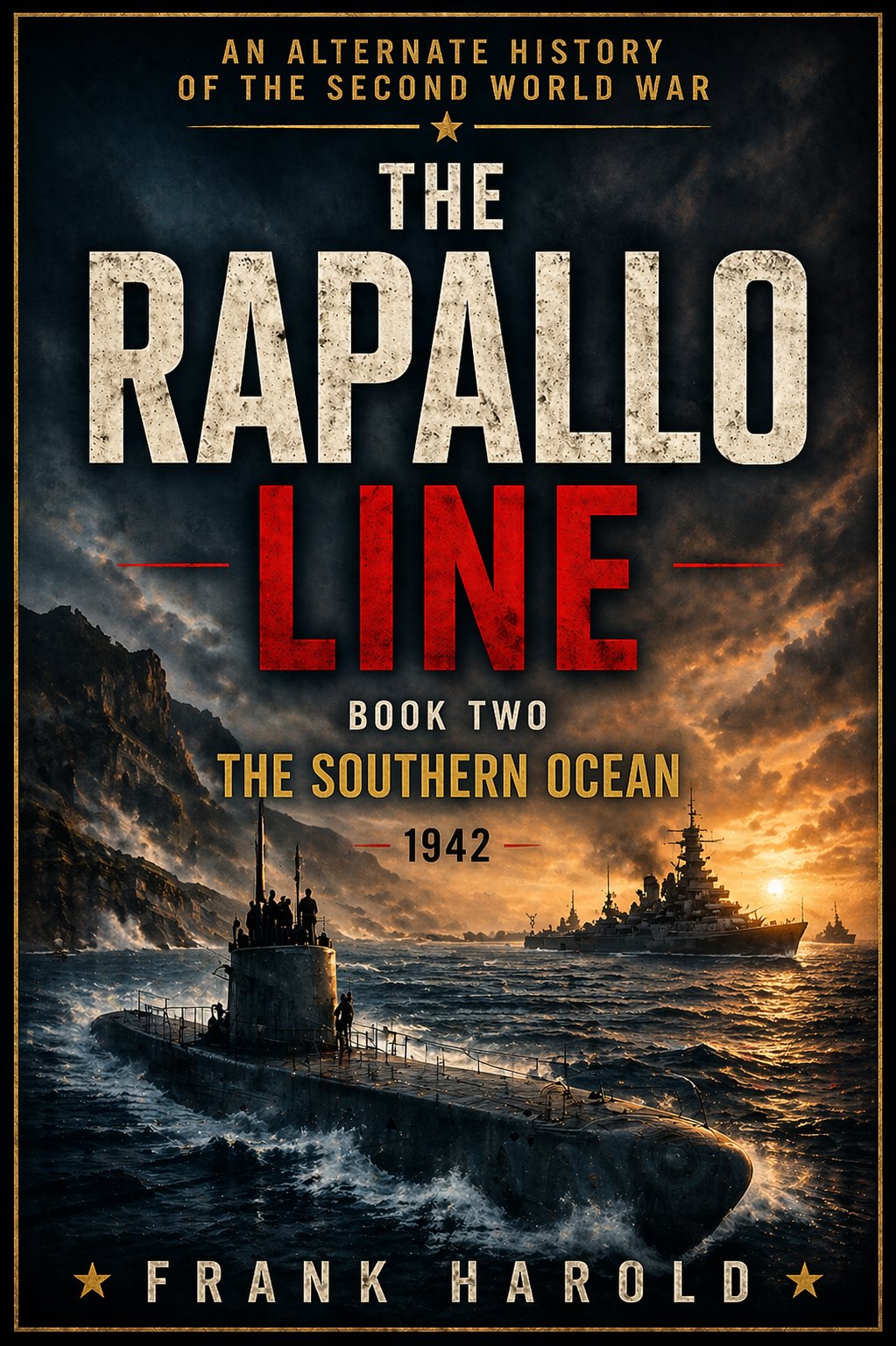
A taste of the opening
Read the first pages
The opening of the book — roughly 3,226 words — to let the voice do its own argument.
Author’s Note
The Rapallo Line is a work of alternate-historical fiction. Its premise — that the Rapallo Pact between the German Reich and the Soviet Union, signed in 1922 and renewed in 1939, held through the Second World War and reshaped the alliances of the decade that followed — diverges deliberately from the historical record. Named figures, including Adolf Hitler, Joseph Stalin, Winston Churchill, Franklin D. Roosevelt, Reinhard Heydrich, and Heinrich Himmler, appear in invented situations; their dialog and specific actions in these novels are fictional.
The Holocaust is referenced in this series because any honest counter-factual set in occupied Europe must reckon with it; I have tried to depict those references with the gravity the subject demands, and without invention of new atrocities beyond the historical record.
Readers interested in the real history against which the alternate is set will find a short discussion in the Historical Note that follows.
A Historical Note
This novel continues the alternate history of the Rapallo Line. The book opens in January 1942. By that date the divergence — a decision taken in Berlin on the morning of the sixth of March 1933, when the secret Rapallo military cooperation arrangements between Germany and the Soviet Union were not closed — has produced a different war. Pearl Harbor did not happen. The United States is not yet at war. The Reich and the Soviet Union remain bound by a pact whose existence the public on either side of the Atlantic does not yet recognize. A fuller account of the real history against which the novel is set will be found in the Historical Appendix at the end of this book.
CHAPTER ONE
The New Year
London, Storey’s Gate, 1 January 1942
The new year came into London on a fog so dense that the pigeons in St James’s Park could be heard but not seen. The cold had a sharp, close quality, as if the city had been shut inside a drawer; the taxis felt their way along the Mall at walking pace, and in Whitehall the sandbags along the east side of the Foreign Office glittered with a gray frost that would not lift before noon.
Captain Peter Ashworth — he had been promoted, quietly, in November — walked across Birdcage Walk at half past six and was already at his desk by the time the others came in. He liked the hour. It was the only hour in which one could think without the telephones.
On his desk was the December summary for the Prime Minister, which he had been asked to distil to a single page. He had not yet managed to distil it to less than four. The trouble was that nothing about the year 1941 reduced well. One could say, truthfully, that the Rapallo Pact still held; that the Moscow purges had removed every senior Red Army officer with any serious German experience; that the Japanese had entered the war on the eighth of December, moving south into Malaya and the Dutch East Indies; that they had, with some delicacy, declined to move east against the Americans, and that President Roosevelt had, with some delicacy, declined to move west against them. One could say these things. What one could not do was explain what they meant, because what they meant was that the United Kingdom, at the turn of the year, stood alone on two oceans against three large empires, and there was no language in the files at Storey’s Gate that could convey that truth without sounding hysterical.
Ashworth wrote, in pencil: “The strategic position of His Majesty’s Government at the opening of 1942 is the worst it has occupied at any time in the memory of living men.”
He looked at the sentence for some time and then crossed it out. The Prime Minister did not care to be told what he already knew.
He began again.
“The Rapallo Pact holds. The Tripartite understanding of Berlin–Moscow–Tokyo, concluded in October, appears to be functional. Japanese naval and ground forces are operating south of the equator against British, Dutch and Free French possessions with, as far as can be ascertained, no American interference. The Soviet Union has moved an estimated eleven divisions east to the Manchurian border — but as a reassurance to Japan, not as a threat. German U-boat strength in the Atlantic stands at 91 operational boats, up from 57 in January 1941. Axis land strength in North Africa continues to increase; there is no indication that the expected spring offensive against Egypt will be anything other than the largest we have faced.”
He paused. He rolled the pencil between his fingers.
“Our one asset of the year,” he wrote, slowly, “is that none of our enemies loves any other of our enemies. Their loyalty is to the map. The map, at present, offers them no reason to quarrel. It will do so in time. The task of this Service is to prepare the ground of that quarrel, against the day when they will walk onto it.”
He sat back. It was the best he could do.
At a quarter past seven Miss Latham came in with his tea. She had been his secretary for six months, a widow of thirty-four whose husband had been killed at Tobruk, and she made tea in the strong, sweet, militant way of a woman who had decided to go on living.
“Happy new year, sir.”
“And to you, Miss Latham.”
“The Prime Minister’s private secretary telephoned at six. He wondered if you might come across at ten.”
“Tell him I will.”
“And Colonel Gubbins would like a word. He was on the stair just now.”
“Send him in.”
Gubbins was, by the standards of the building, a cheerful man, which meant only that he was not visibly in pain. He came in with a folder under his arm and set it on the desk and sat down without being asked.
“Warsaw cell is still running,” he said. “Kraków is down. They took three in the week before Christmas. Good people. We do not know yet whether the rot will reach up or not.”
“And Hale.”
“Hale is in Lublin. She is well.”
“That is my one piece of good news this morning.”
“You have so few of them, Peter, I thought I should bring it first.”
They went through the rest. Paris network was undisturbed; Brussels patchy; Oslo all but dead since October; Athens, astonishingly, alive. In Lyon a man had walked into a gendarmerie and offered, for money, to identify three couriers, and had been quietly taken out of the equation by a cobbler on the rue Garibaldi. In Copenhagen a printer was dead who ought not to have been.
“The Japanese,” Gubbins said at the end. “Anything?”
“Not in our line. The Admiralty has the Far East. We are Europe. We will stay Europe.”
“For now.”
“For now.”
When Gubbins had gone, Ashworth stood at his window and looked out into the fog. The park was invisible. The Foreign Office was invisible. The very railings of Storey’s Gate were invisible at ten paces. He thought, as he often thought these mornings, of a German colonel in Paris whom he had never met and had been instructed the year before to touch; whom he had not yet touched, because the channel was not yet ready, and because one did not touch a man of that kind without every precaution in the book and several not in any book; and who, he was beginning to believe, was waiting for the touch without knowing it.
The fog lifted a little at half past eight. It would be down again by dusk.
❖
South China Sea, IJN Chōkai, 3 January 1942
Lieutenant Commander Inoue Tadashi, senior gunnery officer of the heavy cruiser Chōkai, stood on the starboard wing of the bridge in the third watch of the middle night and watched the phosphorescence break along the bow wave, nine thousand yards of it fanning out behind into the black sea. The cruiser was making twenty-two knots on a course of one-nine-zero. The moon had set at twenty-three forty-two. The sky above was clear, without wind, the stars very steady. It was the most beautiful night he had seen at sea in seven years, and he found himself, as he often did on beautiful nights, thinking of his mother’s garden in Kamakura, where a cherry tree his grandfather had planted in 1893 was, at this moment, leafless under a cold rain.
Inoue was thirty-six years old. He had graduated from the Naval Academy at Etajima in the class of 1926, twelfth of one hundred and fifteen, and had served in the cruisers Kyō and Kyōgoku before his first gunnery course at the Yokosuka school. He had passed the advanced course at the Naval War College in 1938. He had been married ten years to a woman named Kimiko and had two children, a boy of seven and a girl of four. He had not seen them since the middle of September.
He liked his ship. The Chōkai was eleven years old and one of four heavy cruisers of the Takao class; she carried ten eight-inch guns in five turrets, and her turrets, under his gunnery department, had shot better in the last fleet exercise than those of any cruiser in the Second Fleet. Vice Admiral Kondo had come aboard in October and had stood on this very bridge-wing and had told Captain Hayakawa, in Inoue’s hearing, that the Chōkai’s gunnery was exemplary. Inoue had bowed and had said nothing. Hayakawa had later told him, privately, that he had been pleased. Hayakawa was not a man who said such things often.
They were, at this hour, twelve hours from the position where they were to rendezvous with the destroyer squadron that would escort them into the anchorage at Cam Ranh Bay. Cam Ranh was the assembly point for the next operation. The next operation had not yet been named in any signal Inoue had seen, but the direction of travel was plain: they were to support the next phase of the southern campaign, which meant, in practice, the sweep through the Netherlands East Indies. Palembang. Batavia. The oil fields and the refineries. The officers’ wardroom had been speaking of nothing else for a week.
He was not an enthusiast of the war. He did not admit this to anyone, not even to Commander Morita, who was his oldest friend aboard. But he had served as assistant naval attaché at Washington for two years in the middle thirties, and he had driven across the American continent in a Ford coupé in the summer of 1936, and he had seen the great wheat lands of Kansas, the iron mines of the Mesabi Range, and the steel mills that ran the length of the southern shore of Lake Michigan. He knew what was in that country. It was why he had wept, quietly, on the twelfth of November, when the official announcement had come through the fleet that Japan and the United States had concluded a neutrality understanding for the duration of the southern campaign, and that no offensive operation would be undertaken by the Combined Fleet against any American possession.
It had been the act of a serious government. He had wept because he had not, until that morning, believed his government to be a serious government.
Commander Morita joined him at the rail. Morita was a navigator and a slow, cheerful, wide-faced man from Sendai, married to a pianist, fond of bad jokes.
“Inoue.”
“Morita.”
“You are thinking about your mother’s garden.”
“I am thinking about my mother’s garden.”
Morita laughed, very quietly, in the way one laughed on a ship at sea at night.
“The captain wishes to see you at zero six.”
“He does.”
“The gunnery report on Kuantan. He wants it clean for the flag.”
“It is clean.”
“It is cleaner than clean. It is magnificent. But he wants it magnificent in the prose of Admiral Kondō, not in the prose of Lieutenant Commander Inoue.”
Inoue allowed himself a small dry smile. The engagement off Kuantan, four weeks earlier, had been the most satisfactory action of his career: the British battleship Prince of Wales and the battle-cruiser Repulse, sunk by air attack, and the Chōkai and her consorts vectoring in on the survivors in weather in which the gunnery had, by any measure, been excellent. He had been mentioned in the fleet dispatch. His father had written him a letter of three pages about it, the first such letter in Inoue’s life.
“I will prepare it in the prose of Admiral Kondō,” he said.
“Good man.”
They stood a moment. The wake ran away behind them, phosphorescent, indifferent.
“Morita. Do you think they will let us go north when the southern thing is finished.”
“North?”
“Home. Home waters. A dockyard refit. Thirty days’ leave.”
Morita considered. He was a careful man.
“The war will be some years,” he said. “There will not be thirty days’ leave for some years.”
“No.”
“Why do you ask, my friend.”
“My boy is seven. When I see him next he will be nine. A boy changes, between seven and nine.”
“Yes.”
“That is all.”
They stood for a while longer. Then Morita clapped him lightly on the shoulder and went back to the chart table, and Inoue stood alone at the rail with the phosphorescence and the stars, and thought about his son, who was learning, this winter, to read.
❖
Paris, rue de Rivoli, 6 January 1942
Oberst Klaus Brandt rose at six and was at his desk by seven. The morning was black and cold, with a thin ice on the gutters along the rue Saint-Honoré, and the concierge’s boy had lit the stove but not very well. Brandt kept his greatcoat on for the first hour and drank two cups of the chicory the embassy served now instead of coffee.
The first cable on his blotter was from Tokyo. It was a courtesy copy, routed through Berlin, of a communication from the Japanese Naval General Staff to the OKM concerning the next phase of the southern operation. Brandt was not a naval officer and the contents were largely meaningless to him; he was reading it because the liaison bureau was under new orders to keep all senior Army officers at the embassy “familiar with the language and habits” of the Japanese, in preparation for what the memorandum called “possible joint operational undertakings of strategic character.” Brandt had read the memorandum three times. He was not clear what a joint operational undertaking between a German army officer in Paris and a Japanese fleet in the South China Sea would consist of, in any practical sense. The memorandum had not been clear on this point either.
The second cable was from Hamburg. His father was in hospital with pneumonia. The prognosis, the physician wrote, was guarded. Brandt read the cable twice and set it face-down and did not move for perhaps three minutes.
Weiss knocked.
“Herr Oberst. The reception at the ambassador’s at six. Captain Onoda of the Imperial Japanese Navy.”
“Yes.”
“You are to be introduced. The ambassador asked particularly. There is, I understand, a seating.”
“Very well.”
Weiss hesitated. He knew Brandt’s silences, by now, better than Brandt did himself.
“The Herr Oberst has received news.”
“My father is ill.”
“I am sorry, Herr Oberst.”
“Send flowers to the Eppendorf hospital, Weiss. In my name. And telephone my sister at her office. I cannot reach her from here.”
“Jawohl, Herr Oberst.”
Weiss went. Brandt turned the Tokyo cable over again and tried to read it and could not. He was thinking about his father, Gustav, seventy-one years old, a retired Reichstag deputy of the Center Party, a man who had voted against the Enabling Law in 1933 and had paid a price for it through nine intervening years in small humiliations, the loss of committee seats, the quiet cancellation of a scholarly pension, a visit by the Gestapo in 1938 that had lasted four hours and had ended, mysteriously, with a handshake and an apology. Gustav Brandt was alive because his son was a colonel in the Wehrmacht, and Brandt knew this, and Gustav knew Brandt knew, and it was the one subject on which the two men had not, in their lives, directly spoken.
The third cable on the blotter was from Minsk. It announced, in the flat prose of the liaison bureau, that Colonel General Yakir had been awarded the Order of Lenin “for faithful service” and had been appointed to command the newly formed Baikal Military District. It was, Brandt knew, the standard formula for a man whose face had just been pushed through a wall. Yakir was the sixth senior Red Army officer with Kazan experience to be so honored in the eight weeks since October. Brandt folded the cable and put it in the drawer where he kept the others. The drawer was locked. He did not know what he was keeping them for.
He opened the drawer again and looked at the cables. Then he closed it.
“I am forty-three years old,” he said, quietly, to the empty room, in German. “I have been a soldier since I was seventeen. I have been a decent officer in an indecent time. I am beginning to think that the indecent time is winning.”
He said nothing more. He picked up the Tokyo cable and, this time, read it through.
❖
Lublin, General-Gouvernement, 9 January 1942
Eva Hale — she had been Eva Halberstamm once, and was now, on the identity card in her coat, one Ewa Nowak, a bookkeeper from Kielce — stood at the window of the second-floor room on Krakowskie Przedmieście and watched the German lieutenant cross the square for the third time in forty minutes.
He was young. Twenty-two, perhaps. He was cold; he had his hands under the collar of his coat and he was walking with the slightly bouncing step of a man who has not yet learned to be bored. Eva had been told to expect him. She had not been told that he would cross the square three times.
The courier was late.
It was nineteen minutes past eleven and the courier had been due at eleven. In the teaching they had given her at Aberdour — MacRae, the Highlander, patient as a stone — a courier was late at eleven-five. A courier was compromised at eleven-fifteen. A courier at eleven-nineteen was either dead or a decoy, and in either case one was to leave the premises by the back staircase, walk two streets west, take a tram to the Lublin castle, and wait in the cathedral until one’s own relief came.
She had her coat on. She had her gloves on. She had the small pistol in her right coat pocket — a Walther, not a Sten, because the Sten was not a city weapon — and the cyanide ampoule in the seam of her collar. She had been taught, by MacRae and by the other one whose name she had never been told, that the ampoule was not for the enemy. It was for her. It was because, if she were taken, she would talk. Everyone talked. The only question was what one had to say.
End of sample
Continue reading
The full 68,614-word book is available on Amazon as a Kindle ebook.
Available on Amazon →