
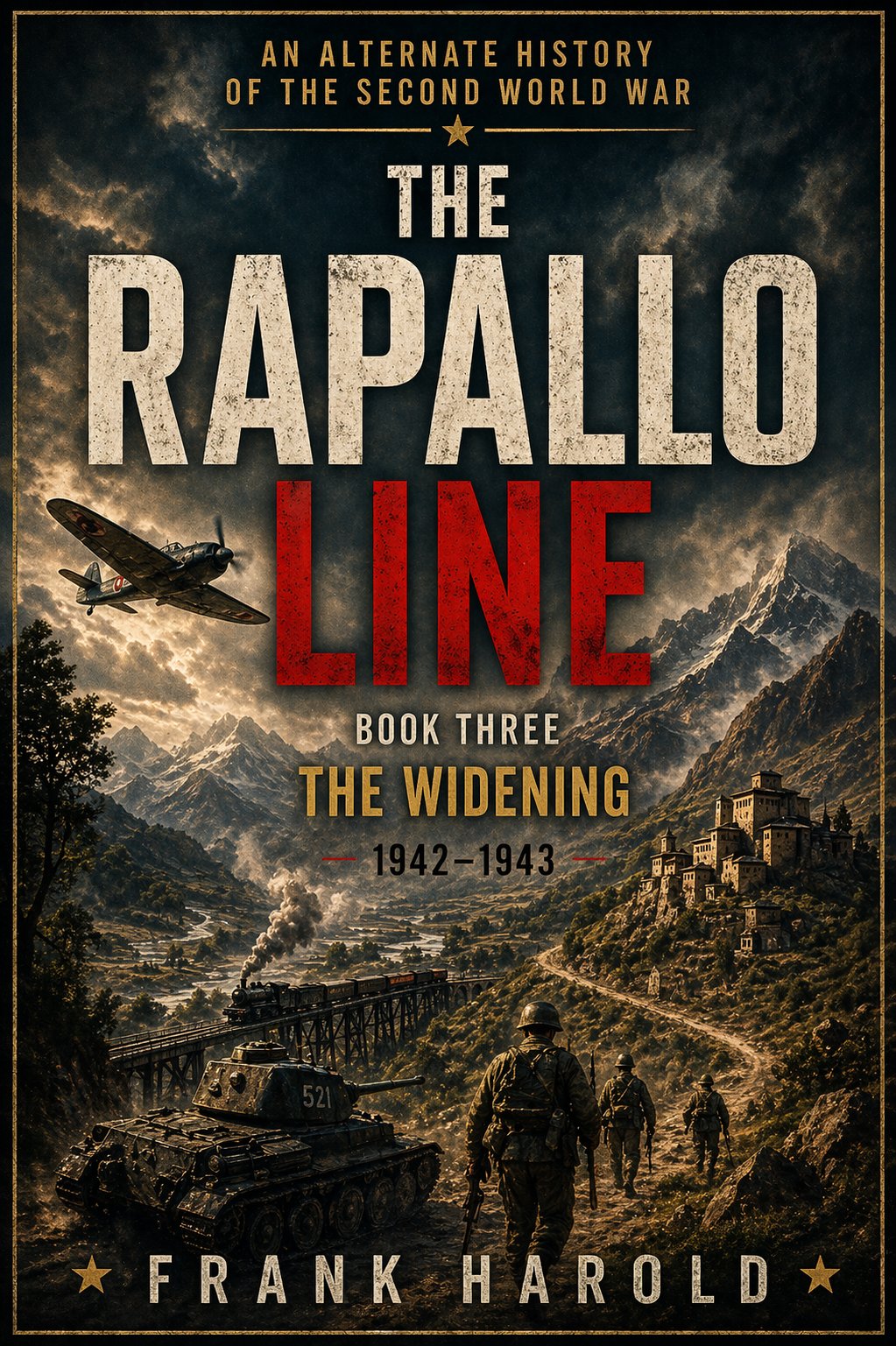
A taste of the opening
Read the first pages
The opening of the book — roughly 3,206 words — to let the voice do its own argument.
Author’s Note
The Rapallo Line is a work of alternate-historical fiction. Its premise — that the Rapallo Pact between the German Reich and the Soviet Union, signed in 1922 and renewed in 1939, held through the Second World War and reshaped the alliances of the decade that followed — diverges deliberately from the historical record. Named figures, including Adolf Hitler, Joseph Stalin, Winston Churchill, Franklin D. Roosevelt, Reinhard Heydrich, and Heinrich Himmler, appear in invented situations; their dialog and specific actions in these novels are fictional.
The Holocaust is referenced in this series because any honest counter-factual set in occupied Europe must reckon with it; I have tried to depict those references with the gravity the subject demands, and without invention of new atrocities beyond the historical record.
Readers interested in the real history against which the alternate is set will find a short discussion in the Historical Note that follows.
A Historical Note
This novel continues the alternate history of the Rapallo Line. The book opens in October 1942. By that date the war has reached its apparent apex: Cairo has fallen to the Axis, the United States remains neutral, and Soviet forces have, on the fifteenth of October, crossed the frontier into northern Persia. The Rapallo Pact, which began as a covert arrangement between Weimar Germany and Soviet Russia and which forms the central counterfactual of the series, has held in Europe and is widening, in 1942 and 1943, into a strategic geometry that governs three continents. A fuller account of the real history against which the novel is set will be found in the Historical Appendix at the end of this book.
CHAPTER ONE
The Crossing
Moscow, Znamensky Pereulok, 3 October 1942
Colonel Sergei Ivanovich Pavlenko came into the map room on the third floor at the hour he had come into it every morning for fourteen months, which was five minutes before seven, and hung his greatcoat on the peg by the door, and went to the stove to see whether the orderly had kept the fire in. The orderly had kept the fire in. Pavlenko held his hands over the stove for the time it took a man to say a short prayer, which he did not, and then he went to his desk.
The desk was set, as all the desks in the room were set, under a section of the great southern map. The southern map covered the whole of the southern wall of the room and ran from the floor to within a foot of the ceiling; it had been drawn in the summer of 1941 by a draughtsman from the General Staff topographical service and had been, since that August, the single largest object in Pavlenko’s life.
On it were shown, in red, the positions of the forward elements of the Transcaucasus Front and the Central Asian Military District as of the previous evening’s report. In blue, the positions of the Imperial Iranian Army. In yellow, the positions of the British Persia and Iraq Command. The red positions had moved, in the last eight weeks, steadily southward, from a line running along the Soviet frontier to a line running through Tabriz, Rasht, and — as of the evening of the second — a point twelve kilometers short of Qazvin. This had been done without a shot fired. The Iranian Army had not resisted. The British had not yet decided what to do.
Pavlenko unlocked his desk drawer and took out the operational folder marked Y, Yuzhnaya, Southern. He opened it to the current working page, which was the movement order for the third phase of the operation. The third phase would carry the forward elements from Qazvin to a line running through Hamadan, Kermanshah, and Ilam, and would put Soviet forces within seventy kilometers of the Iraqi oilfields at Kirkuk.
The order was dated the fourth of October and was to be executed on the twelfth. It would be signed, today, by General Antonov, the Deputy Chief of the General Staff. The signing would take four minutes. Pavlenko had laid out the papers the evening before, and had checked them again at a quarter to seven.
At seven, the orderly brought tea. At five past seven, Major Krasnov came in from the operational section with the overnight teleprinter take from the Transcaucasus Front. They read it together, without speaking. The take contained nothing that altered anything. Krasnov took the sheets away and filed them.
At half past seven, General Antonov’s aide came in to say that the General would be with them at nine. Pavlenko thanked him. He sat down at the desk and opened, from his briefcase, the second folder he carried every morning — a folder of no operational significance, containing only the papers of his own private study, on which he had been working for the better part of seven years and which he did not intend, in this life, to finish. The study was on the use of railways in the Russian Civil War. It was not important. It was what he did, each morning, for the quarter of an hour between half past seven and a quarter to eight, to remember that he had once been a young man who thought, and that in some attic of his life he was a young man still.
At a quarter to eight he closed the second folder and put it back in the briefcase, and returned to the operational folder marked Y.
At nine, General Antonov came in. He was a heavy man with a pale face and quiet hands, and he wore, at this hour, the thick woollen tunic of an older style of uniform, preferred because it was warm. He did not sit down. He stood at Pavlenko’s desk and read the movement order for the third phase in the manner of a man who had read it several times already and was reading it now because the signing of a thing required, even when the thing was known, one final reading. He read it to the end. He put the sheet down. He took the pen from Pavlenko’s hand. He signed. He passed the pen back.
“Thank you, Sergei Ivanovich.”
“Comrade General.”
“The twelfth, then.”
“The twelfth.”
Antonov looked, for a moment, at the map. He looked at the red line running through Qazvin and at the yellow line running along the ridge north of Hamadan where a British brigade was reported to be digging in. He did not say anything. He nodded, once, in the general direction of the map, and left.
Pavlenko sat alone in the room with the map and the stove and the signed movement order. He placed the order in the interior pocket of the folder from which it would, in the next hour, be carried by a courier across the courtyard and into the coded-telegraphy section, from where it would be sent by cipher to the forward headquarters at Julfa.
He had been, in 1935, a captain in the Reichswehr technical exchange detachment that had observed the summer maneuvers at Kazan. He had, in the course of that summer, stood beside a German major on the lip of a firing range and watched a T-26 tank engage a target at five hundred meters, and the German major had said to him, in the tentative English that was the common tongue of such exchanges, “We will need, in our lifetimes, to decide whether this is a friendship or a mistake.” Pavlenko had not answered. He had been thirty years old. He had not had, in 1935, an answer to give. He had, in 1942, still no answer. The map on the southern wall of the room was what the lack of an answer looked like.
He went to the stove. He held his hands over it for the time it took a man to say a short prayer, which he did not. He went back to his desk. He opened the daily log and began, in his careful, small hand, to write.
❖
Tehran, the British Legation, 8 October 1942
Ashworth had arrived at Tehran on the fifth, by airplane from Cairo, on a Hudson of the Royal Air Force which had flown over the Negev at a height that made his ears ring and had set him down at the aerodrome at Doshan Tappeh in a heat that, even in October, had reminded him that he was no longer in Europe. The Minister had sent a car. The Minister himself had received him that evening, in shirtsleeves, in the small study at the back of the residency, and had given him, without preamble, two fingers of whisky and a thin, cold assessment of the position.
The Minister was Sir Reader Bullard, who had been at Tehran since 1939, and who was, in Ashworth’s private estimate, the best head of mission east of Cairo. Bullard was a Yorkshireman with the square, patient face of a man who had spent his life in consulates and did not consider it a tragedy. He did not care for Persia. He did not, in particular, care for the young Shah, whom he thought a fool. He liked his work. He was very good at it.
“You will have read the file,” Bullard said.
“I have read the file.”
“It is thin.”
“It is thin.”
“Our assets in the north are three men and a wireless. The wireless has been giving trouble. Two of the men are Armenians; the third is an English-trained Persian who was, until last year, a minor official of the Imperial Bank. He is the only one of them I would trust in a hard place, and I am not certain I would trust him there either. Cairo will have told you the rest.”
“Cairo told me nothing I did not know.”
“Cairo never does. Cairo’s function in the world is to be a place through which messages pass.”
Ashworth allowed himself a small smile. Bullard did not return it.
“Why are you here, Ashworth.”
“Because London believes the Soviets are going to come down the road.”
“London has believed this for some months.”
“London now believes it will happen in weeks.”
Bullard set his whisky down. He did not drink from it again that evening.
“On what.”
“On signals traffic. On movement observed from the air. On a picture we are not entirely ready to put down on paper. On a certain absence of denial through channels which would, in other circumstances, have denied it.”
“A silence.”
“A silence.”
Bullard nodded, slowly, once.
“You will have this office whenever you wish it. You will have such men as I have. You will have whatever I can give you of the country. What you will not have — what I cannot give you — is an army. If they come, Ashworth, we have nothing here to stop them. What we have is an infantry brigade at Qazvin which is at half strength; a second, at Hamadan, which is new out of India and has never fired a shot in anger; and an armored brigade which is, at this moment, still in Egypt and will not be here in weeks. That is what we have.”
“I know what we have.”
“London does not.”
“London is beginning to.”
“Good. When London has finished beginning, perhaps it will tell us what it wishes us to do.”
They sat in silence, for a moment, in the small study with the shutters closed against the heat and the fan turning very slowly overhead. Outside, beyond the wall of the compound, a muezzin began the evening call, and was joined, within the minute, by two others. Ashworth listened. He had heard the call in Cairo. It was not the same here. It had a different edge, less polished, less certain, as though the city had not yet finished deciding what it was.
“I will want,” Ashworth said, “to send someone north.”
“You have someone in mind.”
“I have Faulkner.”
Bullard, for the first time that evening, smiled. It was a small, thin, dry smile, and it did not reach his eyes.
“Faulkner,” he said, “is an unusual officer.”
“He is.”
“I have had Faulkner north, myself, three times. I would not send him a fourth unless I had to.”
“I have to.”
“Then send him. He will go. He will go because you ask him. He will not ask you why, and he will not tell you, afterward, what he saw, unless you ask him particular questions to which he will give particular answers. Do not expect of him the written report. Faulkner does not write reports.”
“I know Faulkner.”
“You knew him in London.”
“I knew him at Broadway. He was with me for six months in 1940.”
“Then you know, I should think, what he is.”
“I know what he is.”
They sat for another moment. Then Bullard rose, and Ashworth rose, and they shook hands in the manner of two men who had just agreed to something that neither of them wished to have agreed to, and Ashworth took his leave. He walked back to his room, which was in the residency’s east wing, and he stood at the open window for a long time, and he listened to the city. The heat was going out of the day. The sky, above the cypress at the far end of the garden, was turning the deep, bruised blue of a Persian evening. He thought, as he had thought on the airplane over the Negev, that he had not been in the East before. He thought it would be well, perhaps, to remember that.
❖
Stavka, Moscow. 11 October 1942, 23:40
Stalin did not, as a rule, convene the Stavka at night for operations in which the opening move was a foregone conclusion. He did so on the eleventh of October for the reason that the opening move of the Persian operation was not, in his mind, a foregone conclusion at all, and that he wished those present to understand that it was not. Present were Vasilevsky, newly confirmed as Chief of the General Staff in succession to Shaposhnikov; Zhukov, Deputy Supreme Commander; Antonov, Chief of the Operations Directorate; Voroshilov, who attended all Stavka meetings and contributed nothing but was, for reasons Stalin did not explain, to be included; Molotov, for the diplomatic aspect; and Beria, at the back wall with his notebook. Tyulenev, who commanded the Transcaucasus Front, had been brought up from Tbilisi on the morning train and was at the map with his pointer.
Tyulenev reported. He was a heavy man, cavalry-trained, a survivor of the purges by the narrowest of margins, and he had been told to report briefly.
“Comrade Stalin. The Forty-Fourth Army — Khomenko — is in position along the Julfa axis with four rifle divisions, the Fifth Guards Cavalry Corps, and one tank brigade. The Forty-Seventh Army — Leselidze — is echeloned to the east on the Lenkoran axis with three rifle divisions and mountain support. The combined strength is a hundred and four thousand men, two hundred and forty tanks of which one hundred and ten T-34s, four hundred guns of calibre over seventy-six millimeter, and four hundred and ten aircraft of the Fourth Air Army under Colonel-General Vershinin. The movement south across the frontier is timed for oh-four-hundred on the fifteenth of October. The first objective is the Qazvin road junction; the second is the Qazvin–Hamadan axis; the operational objective, in accordance with the directive of the fourth of October, is the line Hamadan — Kermanshah by the end of the first week of November.”
“And the opposition.”
“Two Persian regiments in the north-west, four thousand men, unreliable, with light equipment and no armor. A British consular intelligence presence of no more than a dozen officers. No regular British formation north of the Persian Gulf.”
“Vasilevsky.”
Vasilevsky spoke from his notes. He was the calmest man in the room.
“Comrade Stalin. The military operation is not a difficulty. The Forty-Fourth will be at Qazvin by the twentieth; at Hamadan by the first of November. The difficulty is not operational. The difficulty is political.”
“Molotov.”
“Comrade Stalin. The German ambassador in Moscow was, in August, instructed by his government to seek assurances concerning our intentions south of the Caucasus. We gave him assurances consistent with the Rapallo Pact. The Germans accepted the assurances because they wished to accept them. On the sixteenth of October — the morning after the operation begins — we will inform Berlin that the operation is a restoration of order in our immediate southern approaches, conducted with regard to the security of the oil installations at Baku, and entirely without prejudice to any existing German strategic interest in the Middle East. The Germans will, I believe, accept this also. They will accept it because they are at present engaged in the Delta operation and do not wish to open a second quarrel with us this autumn. They will accept it, in addition, because they will calculate that our Persian presence, once established, will be an obstacle to the British more than to themselves.”
“And the British.”
“The British will complain. The complaint will be registered by Clark Kerr in Moscow and by Maisky’s counterpart in London. Churchill will make, I believe, a speech in the Commons which will contain no action. The British strategic position, at this hour, does not permit action in Persia. They will do what they did in 1941 at Abadan and are no longer strong enough to do: which is, consult, protest, and observe.”
“And the Americans.”
“The Americans will observe. The President is engaged in the Pacific with Japan — not at war, as you know, but engaged. He will not, in October 1942, be drawn into a third theater of concern. The State Department will make, in its careful phrasing, a statement of regret. That will be the whole of it.”
Stalin nodded. He looked at Zhukov.
“Georgii Konstantinovich. You have been silent.”
Zhukov said: “I have been silent, Comrade Stalin, because I am not persuaded.”
The room, not previously quiet, became more quiet.
“Not persuaded of what.”
“Of the political calculation. Comrade Molotov is probably correct that the Germans will accept the operation in October. I am not certain he is correct that they will accept it in April. The Germans are, at this hour, in Cairo. They will be, by the spring, in Baghdad. If we are in Hamadan and Kermanshah in November 1942, we are between them and their own southern salient, and the Rapallo Pact becomes, from a frontier in Poland, a frontier in Persia as well. Two frontiers are harder to honor than one.”
“You are proposing, Georgii Konstantinovich, that we do not go.”
“I am not proposing that we do not go. I am proposing that we go, and that we understand, going, that we have moved the date on which the Pact ends by a year. It will end, now, not in the autumn of 1944 but in the spring of 1944. We should plan accordingly.”
“Vasilevsky.”
“I concur with the Deputy Supreme Commander. The operation remains correct. The timetable of our western preparations must be adjusted.”
End of sample
Continue reading
The full 56,414-word book is available on Amazon as a Kindle ebook.
Available on Amazon →